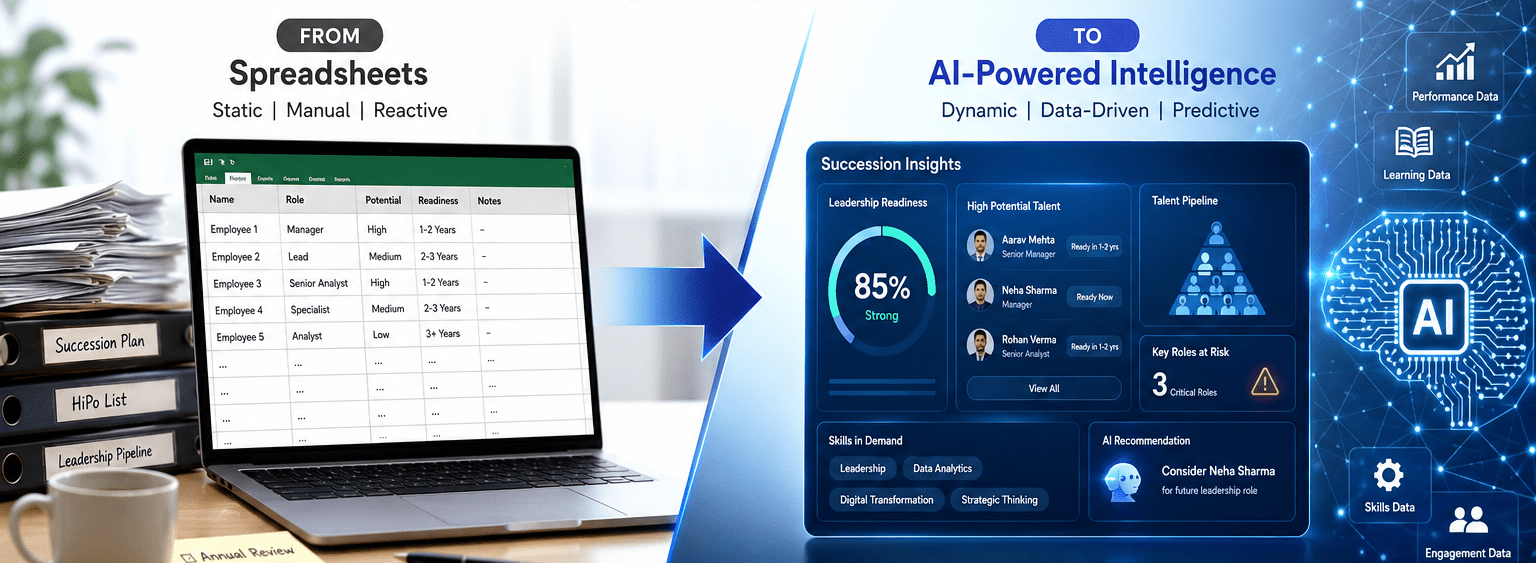
For decades, succession planning in organizations revolved around confidential spreadsheets, annual talent discussions, and a handful of “High Potential” employees identified by leadership teams. While these traditional methods helped organizations prepare future leaders, they were often limited by subjectivity, bias, and outdated information.
Today, the workplace has changed dramatically. Businesses are operating in faster, more dynamic environments where skills evolve rapidly, employee expectations are shifting, and leadership continuity has become more critical than ever. In this new era, organizations can no longer rely solely on intuition to identify future leaders. Succession planning is evolving from static HiPo lists to intelligent, data-driven talent ecosystems powered by AI and workforce analytics.
The future of succession planning is not just about replacement planning, it is about building agile, future-ready leadership pipelines.
The Traditional Era of Succession Planning
Historically, succession planning was largely manager driven. Leadership teams identified a select group of employees as “HiPos” based on performance, visibility, and managerial perception. These employees were then considered for future leadership opportunities. The process typically involved:
- Annual talent reviews
- 9-box grid discussions
- Leadership nominations
- Performance history evaluations
- Limited development planning
While effective to some extent, the model had several limitations.
Common Challenges of Traditional Succession Planning
- Subjective Decision-Making
- Leadership potential was often based on manager opinions rather than measurable capabilities.
- Bias and Visibility Issues
- Employees with greater visibility or stronger manager relationships often received more opportunities, while hidden talent remained unnoticed.
- Static Talent Data
- Succession plans were reviewed annually, making them outdated in rapidly changing business environments.
- Focus on Performance Over Potential
- High performance in a current role did not always indicate future leadership readiness.
- Limited Workforce Insights
- Organizations lacked real-time visibility into employee skills, aspirations, mobility, and development readiness.
- As organizations became more global, digital, and skill-driven, these limitations became increasingly visible.
Why Succession Planning Needed to Evolve
The modern workforce demands a more agile and intelligent approach to leadership planning. Several workplace shifts have accelerated this transformation:
- Hybrid and remote work models
- Rapid skill evolution
- Increased leadership attrition
- Cross-functional career movement
- Greater focus on employee growth
- Demand for transparent career pathways
- Need for diversity and inclusion in leadership pipelines
In today’s environment, organizations must answer critical questions continuously:
- Who is ready to lead now?
- Which skills will future leaders require?
- What leadership gaps exist across the business?
- Which employees show strong growth potential?
- Where are succession risks increasing?
Traditional succession planning models struggle to answer these questions effectively. This is where data intelligence and AI are transforming the process.
The Rise of Data-Driven Succession Planning
Modern succession planning is becoming a continuous, insight-led process powered by workforce data, skills intelligence, and predictive analytics.
Rather than relying solely on annual talent reviews, organizations are now using multiple data sources to identify leadership readiness and future potential.
The Shift from Traditional to Intelligent Succession Planning
| Traditional Approach | Modern Data-Driven Approach |
|---|---|
| Annual reviews | Continuous talent insights |
| Manager opinions | Multi-source workforce data |
| Static HiPo lists | Dynamic talent pipelines |
| Performance-focused | Potential and capability-focused |
| Reactive replacement planning | Predictive leadership readiness |
| Limited visibility | Enterprise-wide talent intelligence |
This evolution enables HR teams to make more informed, objective, and future-focused succession decisions.
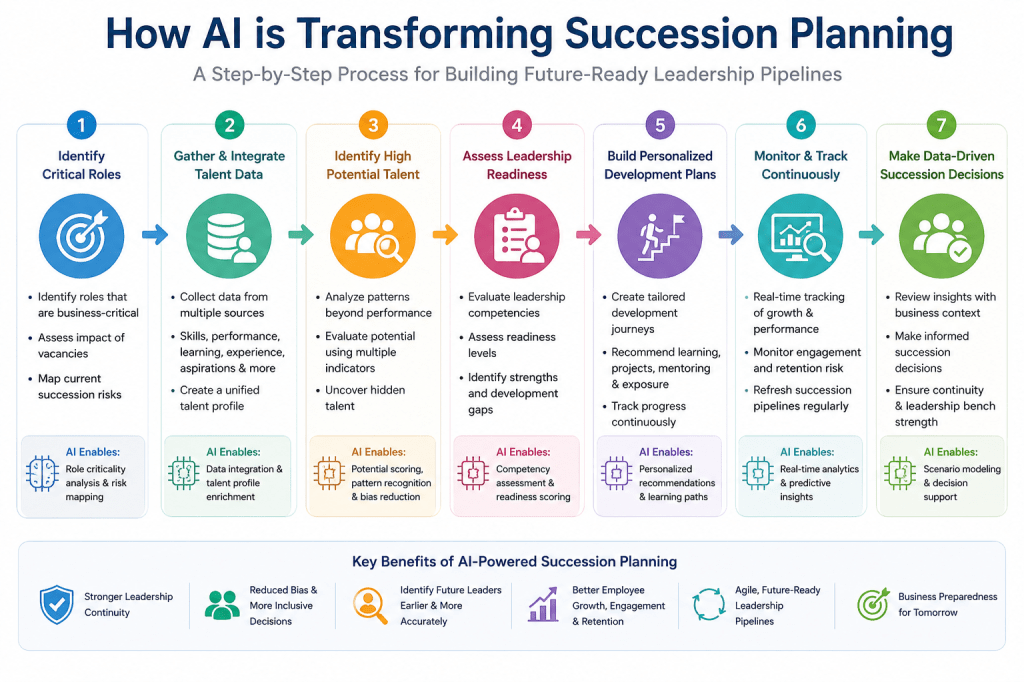
The Human Side of AI in Succession Planning
While technology brings speed and intelligence, succession planning remains deeply human. Organizations must carefully balance:
- Data privacy
- Ethical AI usage
- Transparency
- Human oversight
- Fairness in talent decisions
AI should never become a “black box” for promotions or leadership selection. The role of HR is critical in ensuring that technology enhances inclusion, development, and fairness rather than reinforcing hidden biases. The most successful organizations will combine data intelligence with human empathy, business understanding, and leadership judgment.
The Future of Succession Planning
The future of succession planning will be increasingly skills-based, predictive, and employee-centric. Organizations are moving toward:
- AI-powered career pathing
- Internal talent marketplaces
- Real-time leadership readiness insights
- Skills-first workforce planning
- Dynamic talent ecosystems
- Predictive workforce analytics
The organizations that succeed will not simply identify replacements for leadership positions — they will continuously build leadership capability across the enterprise.
The future of succession planning is no longer about maintaining a confidential list of successors. It is about creating continuous leadership readiness powered by data and guided by human insight. Organizations that embrace this evolution today will build resilient leadership pipelines for tomorrow.

